
money line palm reading short
In this article
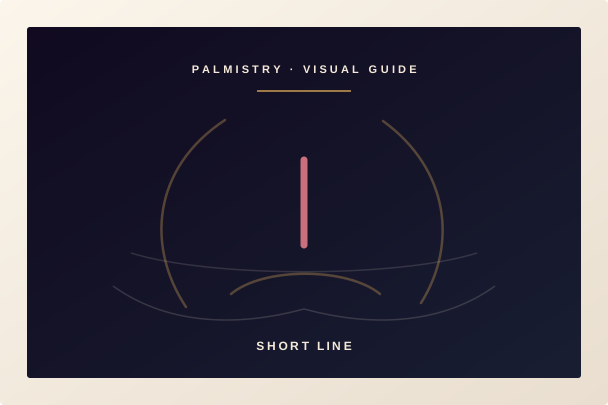
This guide describes symbolic palmistry traditions. Palm lines do not diagnose health or predict lifespan or income. It does not provide an AI analyser or photo upload.
The idea of a “short money line” in palm reading is widely misunderstood because modern explanations often treat the length of a supposed financial line as factual evidence about wealth or material outcomes. This interpretation is frequently presented as ancient and authoritative, even though historical sources do not clearly document such a distinction. As with other palmistry claims, symbolic interpretation is often mistaken for historically grounded fact.
Defining a “Short Money Line” Historically
In contemporary palmistry language, a “short money line” typically refers to a vertical or slanted line—often inconsistently defined—that does not extend far across the palm. Historically, however, palmistry texts do not define a discrete money line at all, let alone classify it by length.
Early palmistry sources described hand markings in broad, symbolic terms. Line length was not quantified, standardized, or compared across individuals. Without agreed terminology, anatomical location, or measurement criteria, the category of a “short” money line lacks historical definition. Claims that such distinctions were evaluated by qualified professionals are therefore unsupported by primary documentation.
Wealth Symbolism in Early Palmistry Traditions
In ancient Indian, Chinese, and Greco-Roman traditions, wealth was discussed in ethical, moral, or cosmological terms rather than anatomical ones. When hand reading appeared in these contexts, it was descriptive and holistic. Financial status was inferred symbolically from the overall hand, not derived from the length of a single line.
Medieval European palmistry, influenced by astrology and humoral theory, continued this approach. Prosperity was sometimes associated with planetary symbolism, but not with measurable features such as short or long lines. The historical record shows no attempt to isolate wealth indicators by line length.
Textual and Archaeological Evidence Review
A review of surviving palmistry manuscripts reveals no textual evidence that line length was used to assess money-related facts. Illustrations that survive are schematic and stylized, lacking proportional accuracy. This strongly suggests they were not intended for anatomical measurement or comparison.
Archaeologically, there is no material evidence—such as charts, instructional tools, or standardized diagrams—demonstrating that short money lines were identified or evaluated. What the evidence shows is symbolic representation shaped by cultural values; what it does not show is a systematic method for assessing wealth through line length.
This absence is decisive when evaluating claims of historical legitimacy.
Emergence of Length-Based Money Interpretations in Modern Palmistry
The interpretation of short versus long money lines emerges primarily in nineteenth- and twentieth-century popular palmistry. During this period, palmistry was simplified and reorganized to appeal to modern audiences. Line length became a convenient variable because it offered visual specificity without requiring historical justification.
This development coincided with the commercialization of interpretive services and the rise of generalized readings offered by reliable readers. In this environment, short money lines were framed as traditional indicators, despite lacking precedent in earlier texts. Historically, this represents innovation rather than continuity.
Scientific Perspective on Short Palmar Lines
From a scientific standpoint, palmar lines are studied within dermatoglyphics. Research shows that these creases form during fetal development and are influenced by genetics and mechanical forces in the womb. Minor palmar creases vary naturally in length and visibility.
No peer-reviewed studies demonstrate a correlation between the length of any palmar line and wealth or financial status. There is also no plausible causal mechanism by which a crease formed before birth could encode later economic outcomes. Modern interpretive settings, including online tarot sessions and video readings, may reference short money lines, but these references do not introduce empirical evidence.
Evaluating the Core Claim With Evidence
The core claim is that a short money line in palm reading has factual meaning regarding wealth. Evaluating this claim requires assessing historical continuity and empirical support.
Historically, continuity is absent. No ancient or medieval text defines a money line or assigns meaning to its length. Empirically, scientific research on palmar anatomy provides no support for correlating line length with financial facts. What exists instead is a modern symbolic framework repeated across contemporary interpretations.
On evidentiary grounds, the claim does not hold. There is no historical documentation or scientific data supporting the idea that a short money line conveys factual information.
Separation From Other Interpretive Systems
Length-based money interpretations are often reinforced through association with other divinatory practices. In contemporary contexts, palm reading is frequently bundled with astrology or card-based interpretation, creating an impression of shared validity.
Historically, these systems developed independently, each with its own symbolic grammar. Even within palmistry, financial symbolism was not reduced to line length. The inclusion of short money line interpretations alongside services such as phone readings or horoscope insights reflects modern packaging rather than documented tradition.
Final Historical Assessment
Based on surviving texts, archaeological context, and scientific research, the interpretation of a short money line lacks historical grounding and empirical support. It represents a modern elaboration rather than a documented, evidence-based tradition.
The factual answer to the central question is therefore clear and unambiguous: no, a short money line does not have evidence-based meaning.
Frequently Asked Questions
Do ancient palmistry texts mention short money lines?
No surviving ancient or medieval texts distinguish money-related lines by length.
Was line length measured historically in palmistry?
There is no evidence of standardized measurement of palmar line length.
Are short palmar lines anatomically unusual?
No, variation in crease length is biologically normal.
When did short money line interpretations appear?
They emerged in modern popular palmistry literature.
Is there scientific evidence supporting these claims?
No scientific studies link palmar line length to wealth.
Are interpretations consistent across cultures?
No, they vary widely and lack historical consistency.
¿Prefieres una lectura personal?
Compara profesionales, disponibilidad y tarifas de teléfono, chat o vídeo. Con la primera recarga recibes 10 € adicionales, según las condiciones de tu cuenta; es distinto de la pregunta gratuita en vídeo.
Por teléfono puedes informarte sobre cómo consultar. El chat y la videollamada se abren desde tu cuenta: créala gratis y recibe 10 € adicionales con tu primera recarga, o entra si ya la tienes.
Read next
Espiritualidad
Free palm reading online: a diagram and guide to your hand
Read your own palm with a labelled diagram, photo tips and specific explanations of heart, life, marriage and other lines. A manual guide with clear limits.
Espiritualidad
Heart Line Palm Reading Short
Heart Line Palm Reading Short. Symbolic meanings, examples and questions to explore.
Espiritualidad
sun line palm reading short
sun line palm reading short. Symbolic meanings, examples and questions to explore.