
Free palm reading online: a diagram and guide to your hand
In this article
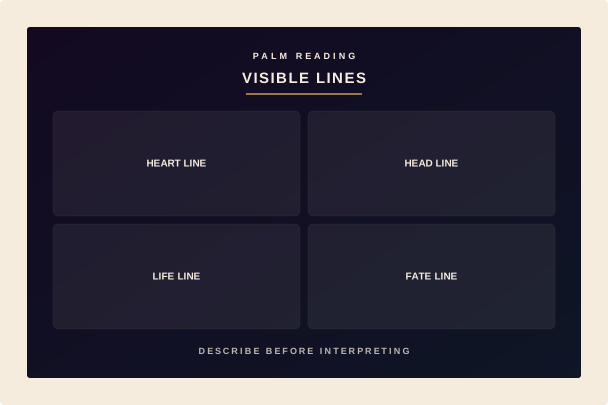
You can try a free palm reading by learning to describe your own hand first. Use the diagram, identify a few visible creases and separate what you observe from the meaning you choose to explore. This is a manual guide: you do not need an account, an upload or an automated report to follow it.
Start with three visible lines
Relax your hand and look in comfortable, even light. Find the thumb first: it gives you a reference even when a photograph is mirrored. The illustration is a simplified map, not a standard every hand must match.
| Line | Where to look | A question you can choose to explore |
|---|---|---|
| Heart line | An upper crease below the fingers | How do I communicate affection and boundaries? |
| Head line | A crease crossing the middle of the palm | What information helps me make a decision? |
| Life line | A curve around the padded base of the thumb | Which routines do I want to keep or change? |
| Fate line | A more vertical marking towards the middle finger, if visible | How do my plans relate to my circumstances? |
The questions in the final column are writing prompts. A line does not answer them for you. Choose one, describe a real example and decide whether the prompt is useful.
Describe before interpreting
Take one line at a time. Record its location, direction, visible length and continuity. “A crease divides near its end” is an observation. “I will have two marriages” is an unsupported conclusion added to it.
A photo can make a faint section disappear into shadow. Try moving the light or relaxing the hand before describing a break. Do not press, stretch or repeatedly examine the skin to force it to match a diagram. Some creases do not fit a familiar palmistry label, and they can remain unnamed in your notes.
Short, long, broken and forked lines
| Feature | What the word describes | What it does not establish |
|---|---|---|
| Short | A visible line ends sooner than another reference in the image | A shorter life, less love or limited success |
| Long | A crease extends further across the photographed area | A stronger ability or a guaranteed outcome |
| Broken | A visible gap or interruption | Illness, trauma, a separation or a dated life event |
| Forked | A line divides into two or more visible branches | Two partners, a move abroad or competing destinies |
| Faint | A line is difficult to distinguish in those conditions | Weak emotions, poor vitality or an absent personality trait |
Avoid comparing lengths between photographs with different scales. The descriptive words have no single measurement standard in this exercise. They should help you describe an image, not rank people.
Heart line: love, forks and the soulmate question
A short heart line does not show that someone loves less. A broken heart line does not prove an emotional wound, and a forked heart line does not identify a love triangle. Look at the shape first, then use a voluntary question such as: “When did I last say clearly what I needed?”
The expression soulmate love line adds a relationship story to the same broad area. There is no feature here that identifies a particular partner. If you are curious about a connection, observe how the two of you communicate, respect boundaries and follow through on plans.
For example, instead of writing “this fork means we are compatible,” write “we have different preferences about time together; I want to ask how we can agree on them.” That gives you something you can actually discuss.
Marriage lines: location and limits
The small horizontal creases on the outer edge of the palm below the little finger are often called marriage, union or relationship lines. This edge is easy to miss in a straight-on photograph. A slight change of angle can help you see what is there, without squeezing the hand.
Their number is not a count of marriages. A branch or gap does not announce divorce, infidelity or a wedding date. The name describes a traditional interpretation, not a personal record. If your interest is commitment, ask what that word means to you and whether it has been discussed with the person involved.
Life line: no lifespan forecast
The life line curves around the thumb base. A short life line does not tell you how long you will live. A broken life line is not a diagnosis or a warning that a particular age will be dangerous. A forked life line can be recorded as a fork without converting it into a prediction about travel, family or health.
A reflective exercise can stay ordinary: name a routine that supports your day, one that costs more effort than it is worth, and one small adjustment you want to try. The value comes from observing your routine, not from the crease.
Smaller lines and the Mount of Venus
The following terms occur in palmistry literature. Their names and claimed meanings vary, so begin with location rather than trying to find every feature.
| Traditional feature | Area described | Specific misconception to avoid |
|---|---|---|
| Sun line | A line towards the ring finger | A short line does not limit recognition; a fork does not promise two successful careers |
| Money line | An inconsistent label used for different upward lines | Short or faint markings do not measure wealth or earning potential |
| Health or Mercury line | A diagonal or upward line towards the little-finger side | A break is not evidence of illness, and the line cannot diagnose a condition |
| Intuition line | A curved marking near the outer, lower edge of the palm | Length or a fork does not establish psychic ability or unusual perception |
| Girdle of Venus | An arc below the fingers and above the heart-line area | Broken or forked sections do not diagnose sensitivity, instability or trauma |
| Mount of Venus | The padded area at the thumb base, inside the life-line curve | Its shape does not measure attraction, fidelity or sexual behaviour |
A historical example is Cheiro's Palmistry for All (1916), which uses many of these names and illustrates hand features. It documents one author's system; its claims about character, health and fate are not evidence that those predictions work. Read the historical book and diagrams.
Left hand, right hand and palm reading for women
You can examine both hands, noting which is dominant. Some traditions describe one as inherited tendencies and the other as current expression; that is an interpretive convention, not a demonstrated reading of your history.
Being a woman does not make the left hand a reliable map of emotions, marriage or fertility. Nor should a reader use a crease to tell you how maternal, independent or sensitive you must be. In this exercise, the same observation steps apply to everyone. If you prefer one hand because it is easier to photograph, simply record that choice.
Using a photo without uploading it
For a manual photo reading, keep the image on your own device:
- Use a plain background and even light, with your hand relaxed.
- Include the palm and finger bases. Take another angle only if you want to see the little-finger edge.
- Avoid beauty filters, strong sharpening and shadows that change how lines appear.
- Compare the image with the diagram and mark observations in a notebook or your own photo editor.
This page does not offer a photo-upload or AI palm analyser. If another service invites you to upload a picture, check who receives it, how long it is kept, whether a report costs money and how to delete it. Ask permission before sharing someone else's hand or any identifying details visible in the photograph.
AI report, written guide or live reader?
A tool can identify an image feature without proving a spiritual interpretation attached to it. When an AI report names a line, ask whether the result shows what was detected, how uncertain the detection is and where the interpretation comes from. A detailed paragraph is not evidence that the system understood your life.
A written guide lets you inspect the method. A live reader adds conversation, but a price, a professional title or a longer session does not validate predictions. Confirm the actual service and language before booking; this guide does not certify that every tarot reader also offers palmistry.
Finish with one observation and one question you want to explore. You can keep the notes, change your interpretation or leave the exercise there. No worrying marking creates an obligation to purchase a remedy or another reading.
Frequently asked questions
Can I read my palm here for free?
Yes. Follow the diagram and observation exercise without registering or paying. This is a manual guide; the page does not upload, store or automatically analyse a photograph of your hand.
Which hand should a woman use for palm reading?
You can observe both hands and note which you use most. Rules assigning the left hand to women are interpretive conventions, not a test of personality or a requirement for this exercise.
Does a short or broken life line mean a short life?
No. A crease is not a lifespan forecast. The words short, broken and forked describe appearances, and photographs can make a line look different depending on light and angle.
Can a marriage line identify my soulmate or wedding date?
No. The traditional name does not turn a small crease into evidence of a future wedding, a number of marriages or another person's feelings.
Can I upload a picture for a free AI palm reading here?
There is no photo-upload analyser on this page. You can keep a picture on your own device and compare visible features with the diagram. The guide also explains what to check before sharing a photo with another service.
What if I cannot see an intuition, sun or health line?
Leave it unmarked. You do not need every line shown in a palmistry diagram, and absence of a named feature does not indicate missing talent, poor health or bad luck.
¿Prefieres una lectura personal?
Compara profesionales, disponibilidad y tarifas de teléfono, chat o vídeo. Con la primera recarga recibes 10 € adicionales, según las condiciones de tu cuenta; es distinto de la pregunta gratuita en vídeo.
Por teléfono puedes informarte sobre cómo consultar. El chat y la videollamada se abren desde tu cuenta: créala gratis y recibe 10 € adicionales con tu primera recarga, o entra si ya la tienes.
Read next
Espiritualidad
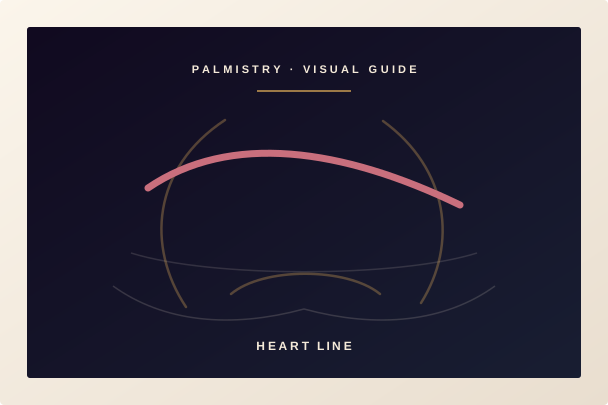
Heart Line Palm Reading Meaning
Heart Line Palm Reading Meaning. Symbolic meanings, examples and questions to explore.
Espiritualidad
health line palm reading marriage
Understand how the health line in palm reading may influence marriage, emotional stability, and long-term relationship health.
Espiritualidad
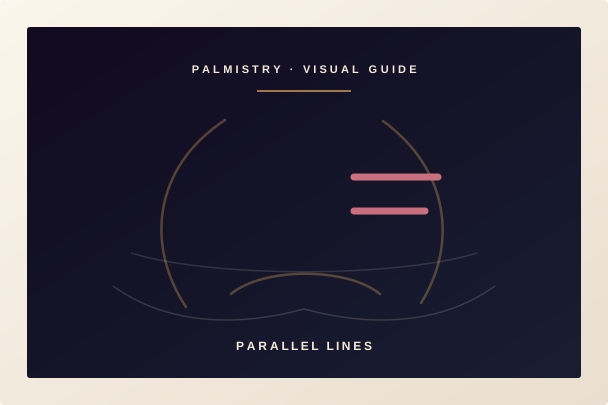
palm reading marriage line
palm reading marriage line. Symbolic meanings, examples and questions to explore.