
Heart Line Palm Reading Meaning
In this article
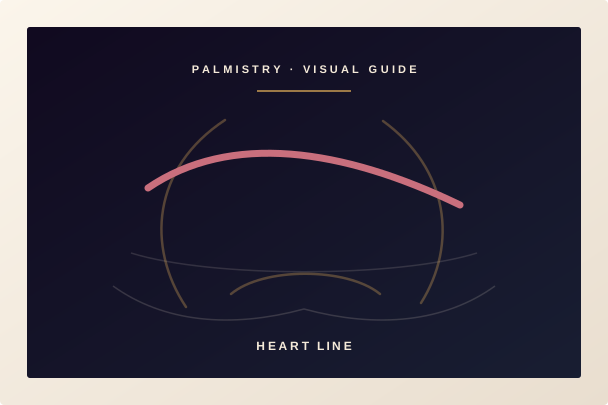
This guide describes symbolic palmistry traditions. Palm lines do not diagnose health or predict lifespan or income. It does not provide an AI analyser or photo upload.
The phrase “heart line palm reading meaning” is widely used in contemporary palmistry, where the line is said to reveal emotional tendencies, romantic capacity, or relationship outcomes. This certainty is historically questionable. The misunderstanding arises from presenting modern interpretive claims as if they were ancient, standardized knowledge.
Defining the “Heart Line” in Historical Terms
In palmistry, the “heart line” refers to a transverse line near the top of the palm, typically running below the fingers. Modern descriptions claim it corresponds to emotions, love, or affection. Historically, however, the term “heart line” itself is not ancient.
For a meaning to be historically grounded, early sources must define the line consistently and attribute a stable interpretation to it. Without such sources, meanings reflect later classification rather than original doctrine. Assertions about emotional or romantic significance often rely on the assumptions of reliable readers rather than documented historical consensus.
Origins of Palmistry as a System
Palmistry, also known as chiromancy, developed across multiple cultures over long periods. Early references appear in South Asian, Near Eastern, and Greco-Roman contexts. These traditions did not form a single, unified system, nor did they share standardized terminology.
Early texts discuss hands and bodily signs broadly, often in relation to health or temperament, but they do not present a universally defined “heart line.” The compartmentalization of the palm into named lines is a later development. Unlike structured interpretive systems such as those presented in online tarot sessions, early palmistry lacked uniform categories.
Textual Evidence from Classical and Medieval Sources
Classical authors who discussed physiognomy and bodily signs—such as those writing in Greek and Latin traditions—did not provide a standardized interpretation of palm lines corresponding to emotional life. Medieval European manuscripts that reference chiromancy vary widely in how they describe hand markings.
Some texts note lines related to vitality or fortune, but there is no consistent mention of a “heart line” with an emotional meaning. The absence of standardized description across manuscripts indicates that the concept was not fixed. Treating later descriptions as ancient knowledge mirrors interpretive certainty closer to video readings than to historical method.
The Emergence of the Heart Line Concept
The explicit identification of a “heart line” with emotional or romantic meaning appears primarily in early modern and modern palmistry manuals, especially from the eighteenth and nineteenth centuries. During this period, authors sought to rationalize and systematize palmistry by mapping bodily features to psychological traits.
This development coincided with broader trends in categorization and pseudo-scientific typology. The heart line became one of several named lines—alongside “head” and “life”—each assigned a domain. These assignments were interpretive choices, not recoveries of ancient doctrine, similar in structure to interpretive models seen in phone readings.
Cross-Cultural Comparison and Inconsistency
Comparative analysis shows that different palmistry traditions assign different meanings—or no fixed meanings at all—to the same line. South Asian, Chinese, and European manuals diverge significantly. Some traditions emphasize mounts or hand shapes rather than lines.
If the heart line had an original, universally recognized meaning, we would expect consistency across cultures and periods. The lack of such consistency indicates that meanings were locally constructed and later standardized. Assigning a single, authoritative meaning resembles modern categorization habits similar to those used in horoscope insights rather than evidence-based historical reconstruction.
What the Historical Record Does Not Establish
A systematic review of classical texts, medieval manuscripts, and early modern palmistry manuals shows that the historical record does not establish:
- A universally recognized “heart line” term in antiquity
- A fixed emotional or romantic meaning assigned early on
- Consistent interpretation across cultures or centuries
- Evidence that the line was central to early palm reading
Where meanings exist, they vary by author and era. The modern heart line meaning is therefore a later synthesis rather than an inherited ancient truth.
Modern Consolidation of Meaning
By the late nineteenth and twentieth centuries, palmistry manuals consolidated interpretations to appeal to broader audiences. The heart line was standardized as representing emotions and relationships, providing a simple explanatory framework.
Evaluating the Core Claim with Evidence
The claim under examination is precise: does the heart line have an original, historically fixed meaning in palm reading?
Based on textual history, cross-cultural comparison, and the chronology of palmistry literature, the answer is no. While lines on the palm have long been observed, the specific identification of a heart line with emotional meaning is a modern interpretive construct. There is no evidence of a single, ancient meaning consistently applied across early traditions.
Frequently Asked Questions
Is the heart line mentioned in ancient palmistry texts?
Not in a standardized or consistent way.
Did early palm readers link the line to emotions?
There is no consistent evidence of this.
Do all cultures interpret the heart line the same way?
No. Interpretations vary widely.
When did the modern meaning appear?
Primarily in early modern and modern manuals.
Do historians consider the meaning ancient?
No. It is considered a later development.
Is the heart line unique in this evolution?
No. Other palm lines show similar patterns.
¿Prefieres una lectura personal?
Compara profesionales, disponibilidad y tarifas de teléfono, chat o vídeo. Con la primera recarga recibes 10 € adicionales, según las condiciones de tu cuenta; es distinto de la pregunta gratuita en vídeo.
Por teléfono puedes informarte sobre cómo consultar. El chat y la videollamada se abren desde tu cuenta: créala gratis y recibe 10 € adicionales con tu primera recarga, o entra si ya la tienes.
Read next
Espiritualidad
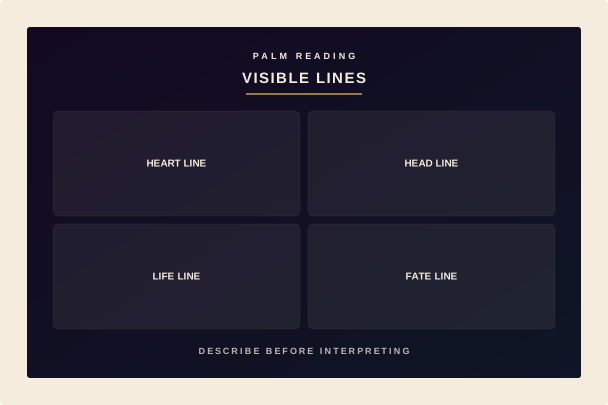
Free palm reading online: a diagram and guide to your hand
Read your own palm with a labelled diagram, photo tips and specific explanations of heart, life, marriage and other lines. A manual guide with clear limits.
Espiritualidad
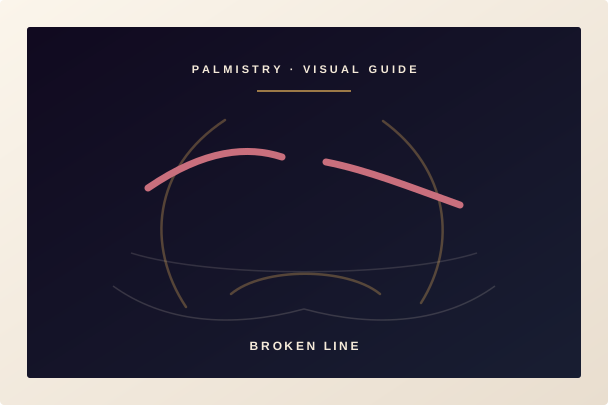
Heart Line Palm Reading Broken
Heart Line Palm Reading Broken. Symbolic meanings, examples and questions to explore.
Espiritualidad
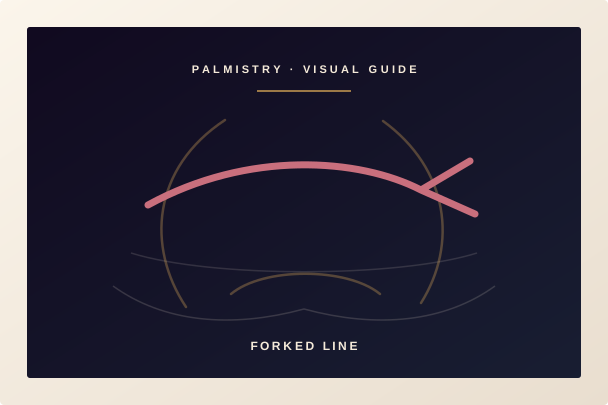
heart line palm reading forked
heart line palm reading forked. Symbolic meanings, examples and questions to explore.