
health line palm reading broken
In this article
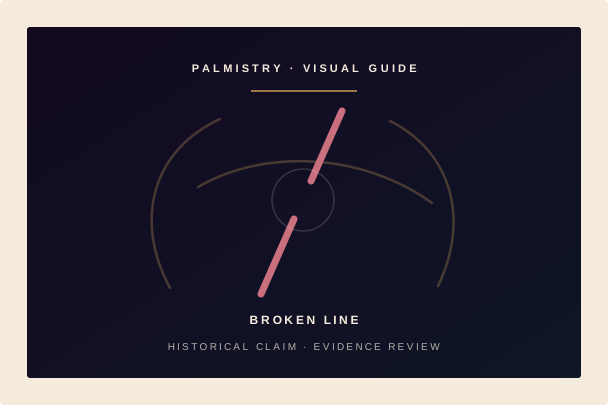
This guide describes symbolic palmistry traditions. Palm lines do not diagnose health or predict lifespan or income. It does not provide an AI analyser or photo upload.
The claim that a broken “health line” on the palm signifies something concrete about physical health is common, persistent, and frequently misunderstood. The misunderstanding arises from compressing historically diverse symbolic traditions into a single visual rule and then presenting that rule as if it carried observational or medical authority. In popular summaries, the appearance of interruptions or gaps in a palm line is often treated as self-evident evidence, even though the historical record does not support such certainty.
This problem is compounded when interpretive material circulates alongside consultations with qualified professionals, without clearly separating cultural belief from factual assessment.
Historical Definition of a “Broken” Health Line
In palmistry literature, the “health line” is traditionally identified with the line of Mercury. A line described as “broken” is one that appears segmented, interrupted, or discontinuous rather than forming a single uninterrupted mark across the palm. At first glance, this definition seems straightforward, but historical sources reveal substantial disagreement.
Some authors considered any interruption to be meaningful, while others dismissed minor gaps as normal variation. Still others argued that only certain types of breaks mattered, without explaining how those distinctions were determined. Importantly, there was no agreed-upon method for identifying what constituted a true break versus natural skin variation. As a result, claims repeated today by individuals presented as reliable readers rest on a concept that was never standardized across the tradition itself.
Cultural and Intellectual Origins
Palmistry developed within symbolic and analogical systems rather than empirical frameworks. Early traditions from South Asia and later adaptations in the Middle East and Europe interpreted bodily features through correspondence with planets, elements, and moral categories. In this context, continuity or interruption in a line was read symbolically, not physiologically.
Textual and Archaeological Evidence
Archaeological evidence does not support the claim either. Artistic depictions of hands across cultures show natural variation in palm creases, including interruptions, but there is no indication that these variations were linked to health outcomes. Modern scientific research that studies the hand—such as dermatoglyphics and clinical genetics—focuses on fingerprint patterns and congenital markers. These disciplines do not treat palmistry lines as medically relevant variables, and their findings do not align with interpretive claims often implied in video readings.
Modern Reinterpretations and Their Context
The idea that a broken health line carries a specific, concrete meaning became more prominent in modern palmistry literature, particularly from the nineteenth century onward. During this period, authors sought to make older symbolic systems more accessible by reducing them to easily communicated visual rules. A broken line offered a dramatic and memorable feature that could be assigned meaning without complex explanation.
These modern interpretations vary significantly. Some portray breaks as indicators of interruption or instability, while others attach entirely different meanings. None of these interpretations cite observational data or medical research. Instead, they rely on reinterpretation and repetition. As these ideas spread through mass publishing and later through remote formats such as phone readings, the appearance of authority increased while the evidentiary basis remained unchanged.
Direct Evaluation of the Core Claim
The specific claim under evaluation is that a broken health line in palm reading has factual or historical validity as an indicator of health. The historical record shows that the claim originates in symbolic traditions that did not employ observational testing. Definitions of what constitutes a “break” are inconsistent, and interpretations differ not only between eras but within the same period.
Why the Interpretation Persists
The persistence of the broken health line claim is best explained by cultural transmission rather than validation. Visual discontinuity naturally invites interpretation, and simple rules about breaks are easy to remember and repeat. Over time, repetition can create an impression of confirmation, even when no supporting evidence exists.
Conclusion: Based on historical documentation and scientific review, the answer is no. A broken health line in palm reading does not have factual or evidentiary validity as an indicator of physical health.
Frequently Asked Questions
Is a broken health line described consistently in historical texts?
No. Definitions and interpretations vary widely across sources.
Did any palmistry tradition test claims about broken lines?
No. There is no record of systematic testing or observation.
Do medical sciences recognize broken palm lines as indicators?
No. They are not recognized diagnostic features.
Are modern meanings based on new evidence?
No. They are reinterpretations without empirical support.
Does symbolic meaning imply physical causation?
No. Symbolic association does not establish causation.
Has any verified study linked palm line breaks to illness?
No. No such link has been demonstrated.
¿Prefieres una lectura personal?
Compara profesionales, disponibilidad y tarifas de teléfono, chat o vídeo. Con la primera recarga recibes 10 € adicionales, según las condiciones de tu cuenta; es distinto de la pregunta gratuita en vídeo.
Por teléfono puedes informarte sobre cómo consultar. El chat y la videollamada se abren desde tu cuenta: créala gratis y recibe 10 € adicionales con tu primera recarga, o entra si ya la tienes.
Read next
Espiritualidad
Free palm reading online: a diagram and guide to your hand
Read your own palm with a labelled diagram, photo tips and specific explanations of heart, life, marriage and other lines. A manual guide with clear limits.
Espiritualidad
Heart Line Palm Reading Broken
Heart Line Palm Reading Broken. Symbolic meanings, examples and questions to explore.
Espiritualidad
life line palm reading broken
life line palm reading broken. Symbolic meanings, examples and questions to explore.