
Eihwaz Rune in Love Reading
In this article
The phrase “Eihwaz rune in love reading” is widely used in modern interpretive contexts, often presented as if it reflects an ancient or historically grounded practice. This framing is misleading. It combines a rune from an early Germanic writing system with a contemporary concept of thematic divination that did not exist when that system was in use. The resulting confusion is factual, not interpretive: it concerns whether there is any historical evidence that Eihwaz was ever used in a context resembling a love-focused reading.
This article treats the subject as a historical evaluation of a modern claim. It does not assess whether love readings are meaningful today, but whether they can be traced back to the documented use of the Eihwaz rune.
The objective is to reach a single, clear yes-or-no conclusion based strictly on available sources.
Defining Eihwaz in Historical Terms
Eihwaz is the conventional scholarly name for one character of the Elder Futhark, the earliest known runic alphabet. The Elder Futhark consists of 24 characters and was used approximately between the second and eighth centuries CE. The name “Eihwaz” does not appear in inscriptions from that period; it is reconstructed from medieval rune poems composed several centuries later.
Historically, Eihwaz functioned as a grapheme with a phonetic role in written language. It was used to represent a sound, not a thematic concept. When historians assess claims about rune meanings, they rely on criteria applied by qualified professionals who prioritize datable inscriptions and contemporaneous texts over later symbolic interpretations.
The Elder Futhark and Its Documented Uses
Archaeological evidence places Elder Futhark inscriptions on objects such as weapons, tools, jewelry, and memorial stones. These inscriptions are generally short and practical, often recording names, ownership, or brief commemorations. They do not contain extended narratives or thematic divisions.
There is no evidence that runes were grouped or interpreted according to life domains such as love, work, or fate. Applying thematic categories resembles modern interpretive frameworks similar to love tarot readings, but this structure is absent from early runic material. The documented function of runes was inscriptional, not interpretive.
Linguistic Evidence and Thematic Attribution
Linguistic reconstruction is often used to justify assigning meanings to individual runes. In the case of Eihwaz, its reconstructed name is associated in later Old Norse and Old English sources with the yew tree. Medieval rune poems reference this association, but these texts date from long after the Elder Futhark had ceased to be used.
Crucially, these poems do not categorize runes by emotional or relational themes. They do not associate Eihwaz, or any rune, with romantic relationships or interpersonal evaluation. Treating the rune as a marker within a love reading reflects interpretive habits closer to those used by reliable readers than to early linguistic evidence.
Archaeological Evidence and Divinatory Claims
Archaeology provides a direct means to test claims of divinatory use. Hundreds of Elder Futhark inscriptions have been cataloged, yet none indicate a reading system or thematic sorting. Runes appear carved into objects for identification or commemoration, not arranged for interpretive analysis.
No archaeological contexts suggest that runes were drawn, selected, or interpreted in ways comparable to modern readings. There are no associated tools, layouts, or ritual spaces that would indicate love-focused divination. Comparisons to interpretive practices such as online tarot sessions reflect modern analogies rather than archaeological conclusions.
Textual Sources and the Absence of Love Readings
Textual evidence from classical and early medieval sources is limited but consistent. Roman authors who described Germanic societies do not mention rune-based readings, let alone love-specific interpretations. Medieval Scandinavian texts reference runes primarily in relation to writing, carving, or marking objects.
When runes appear in narrative contexts, they are associated with inscriptional acts, not with evaluating relationships or emotions. No surviving text describes a practice that resembles a love reading using runes. Modern parallels to practices like video readings do not align with the documented textual record.
Emergence of Love Readings in Modern Rune Use
The association between runes and love readings is a modern development. From the nineteenth century onward, runes were incorporated into symbolic and esoteric systems that borrowed structures from other forms of divination. These systems often divided interpretations into thematic categories, including love.
In the late twentieth century, rune interpretations became integrated with contemporary spiritual services and practices, including phone readings and broader popular divination culture. While influential today, these systems are historically discontinuous from early runic usage. They represent reinterpretation rather than transmission.
Evaluating the Core Claim with Evidence
The central factual question is whether Eihwaz was historically used in love readings or in any comparable interpretive system focused on romantic relationships. Evaluating linguistic data, archaeological evidence, and textual sources yields a consistent answer.
What has been examined includes runic inscriptions, medieval rune poems, classical ethnographies, and material culture. These sources document Eihwaz as a letter within a writing system. They do not document thematic readings, divinatory layouts, or love-focused interpretation. Methodological standards comparable to those outlined by astroideal require distinguishing documented historical practice from modern symbolic frameworks. Based on the available evidence, the answer to the core question is no.
Frequently Asked Questions
Was Eihwaz used in ancient love divination?
No evidence supports this claim.
Do any runic texts describe love readings?
No surviving texts do.
Are rune poems evidence of love symbolism?
They are medieval and do not address love readings.
Did ancient Germanic societies use runes for divination?
There is no clear evidence for structured rune divination.
When did rune love readings appear?
They emerged in the modern era.
Is Eihwaz linked to relationships historically?
No historical sources make that link.
Call to Action
When evaluating claims about ancient divination, examine what primary sources actually document. Use evidence to get a clear yes or no answer rather than assuming modern interpretive practices reflect historical reality.
¿Prefieres una lectura personal?
Compara profesionales, disponibilidad y tarifas de teléfono, chat o vídeo. Con la primera recarga recibes 10 € adicionales, según las condiciones de tu cuenta; es distinto de la pregunta gratuita en vídeo.
Por teléfono puedes informarte sobre cómo consultar. El chat y la videollamada se abren desde tu cuenta: créala gratis y recibe 10 € adicionales con tu primera recarga, o entra si ya la tienes.
Read next
Runas
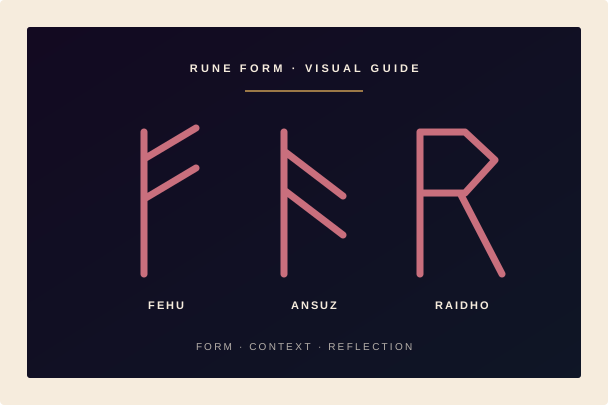
Fehu, Ansuz and Raidho: drawing, love readings and reversals
Draw three recognisable runes and compare their symbolic themes: exchange, communication and shared direction. Includes specific love examples, reversals and a simple notebook practice.
Espiritualidad
Eihwaz Rune Pronunciation
Learn how to correctly pronounce the Eihwaz rune, including phonetic guidance and historical pronunciation insights.
Espiritualidad
Eihwaz rune tattoo
Discover the meaning of an Eihwaz rune tattoo, its symbolism of protection and transformation, and why it represents inner strength and resilience.