
Fehu, Ansuz and Raidho: drawing, love readings and reversals
In this article
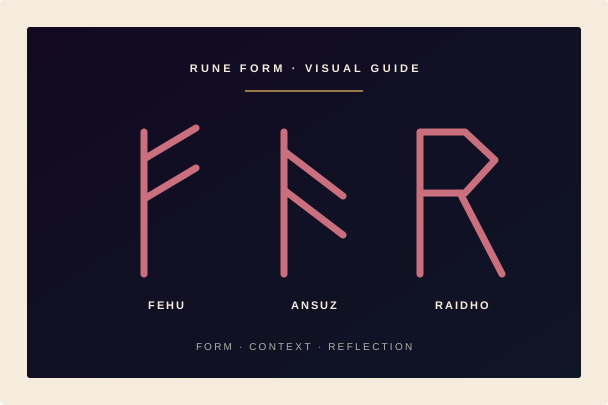
Fehu, Ansuz and Raidho offer three different starting points for a symbolic reading: exchange, communication and direction. This guide shows how to draw them and work with those themes through concrete questions. The exercises are optional interpretations, not historical rules, diagnoses or a way to establish another person's feelings.
Recognise the three shapes
The diagrams are simple original drawings of Fehu ᚠ, Ansuz ᚨ and Raidho ᚱ. Their encoded characters are U+16A0, U+16A8 and U+16B1. The Unicode Runic chart provides a reference for the characters; it does not support the modern reading exercises below.
How to draw Fehu
Draw a vertical stem, then two separate branches rising to its right. Keep both attached to the stem, with a gap between them.
How to draw Ansuz
Draw a vertical stem and two branches sloping down to the right. Compare their direction with Fehu.
How to draw Raidho
Draw a vertical stem, an angular upper loop on its right and a diagonal leg from the middle towards the lower right. Keep the loop: one downward branch alone is incomplete.
Fehu in love: look at the exchange
For a Fehu love reading, try looking at what each person gives and receives in an actual interaction. It might be time, attention, practical help or an opportunity to speak. The symbol is a prompt to examine the exchange; its appearance does not establish that affection is mutual.
An example: you usually suggest meeting, and the other person sometimes agrees. Write what is observable before explaining why it happens. Then identify what you would like to ask, such as whether they want to propose the next plan. Avoid turning a tally of messages into a score of how much either person cares.
If you want to become more involved, name what that would mean in practice. If you would rather step back, you do not need a negative rune to authorise the choice. A warm interaction and a freely chosen commitment are different things.
Fehu reversed: reassess an exchange
Here the reversal invites you to review effort, expectations and what is actually being returned. It might lead to a question about a shared task or an arrangement you want to change. It does not prove that someone is draining you or make a decision urgent.
Try what I offered / what we agreed / what happened. If an agreement was never made, do not fill that column with an assumption. This keeps the exercise specific whether you are considering a relationship, project or use of your time.
A short Fehu meditation or notebook practice
Place the drawing where you can see it. Sit comfortably and notice the shape for a moment. If your attention moves to a task or conversation, note it briefly and return to the drawing if you wish. You do not have to empty your mind or make anything happen.
Afterwards, write one thing that has been taking your attention and one thing you choose to give attention to next. Stop if the exercise is unhelpful. It is a quiet activity, not a treatment or a test of whether Fehu is the “right” symbol for you.
Ansuz in love: what was said and what was understood
The Ansuz rune love meaning used here centres on communication. More conversation does not necessarily answer a particular question; a short clarification may matter more than a long exchange that leaves the same uncertainty.
Choose one actual message and write three lines:
- The words that were used.
- What I understood them to mean.
- What I would need to ask to check that understanding.
For example, “I am busy this week” does not by itself tell you whether someone wants to meet later. You can ask if a future plan is welcome, while allowing them to decline. The rune does not supply the missing answer.
Listening belongs in the exercise too. Before preparing a reply, ask whether you are responding to the actual words or to the outcome you fear or hope for. In a face-to-face conversation, you can check your understanding aloud instead of treating posture or a pause as proof of hidden emotion.
Ansuz reversed: a message that needs clarification
Use the reversal to explore a misunderstanding, missing context or a channel that is not helping. A delayed reply, vague wording and two people using the same word differently are distinct situations.
Select one change you can try: ask a shorter question, explain what a term means to you or agree a more convenient time. The exercise does not label anyone dishonest or require you to keep a conversation going when either person wants to end it.
Raidho in a love reading: agree on the next step
The useful theme for Raidho is how a shared plan takes shape. Frequent contact can coexist with different expectations. Instead of asking whether a connection is “progressing” in the abstract, describe the next step each person actually wants.
For a long-distance relationship, a visit involves dates, travel arrangements and willingness on both sides. For people who are beginning to meet, it may be enough to decide whether they want another meeting. Neither situation needs to follow a fixed sequence towards commitment.
Write step / who agrees / what it depends on. An entry might be “choose a date / both of us / knowing our schedules”. This turns the image of a path into a plan you can discuss. Leave an item unresolved if an agreement is still missing.
Raidho reversed: review timing and coordination
A reversal can prompt you to check a step that was rushed, a condition that changed or different expectations about pace. It need not mean stopping everything. Nor does it confirm that the plan is right but the universe has delayed it.
For example, if one person suggests booking travel before the other confirms availability, the missing step is concrete. Check availability first. The rune is a way to frame that review, not information about the schedule itself.
Raidho tattoos and a beginner's drawing check
If you are considering this shape for a design, decide what it means to you in your own words. Check the stem, upper loop and lower leg before adding ornament. Compare the design itself with a reference; a mirror or reversed photo can make orientation confusing.
A chosen symbol does not acquire a harmful force because you rotated it. You can still decide whether a rotated version matches the design you intended. For a permanent design, take time to understand the form and how it may be read in its context.
Keep shape, interpretation and decisions separate
Use a character reference to check a drawing. Use the exercises to organise a question. Use actual conversation and information to make a decision. These are different tasks, and a rune or a random yes-or-no result does not replace the missing evidence.
You can practise with just one of the three drawings and a notebook. If you compare them, keep the questions distinct: Fehu—what is exchanged? Ansuz—what is understood? Raidho—what is the next agreed step? There is no need to repeat the exercise until you get a preferred answer.
Frequently asked questions
How do I draw the Fehu rune?
Draw a vertical stem and two separate branches rising to its right. Keep both attached to the stem and leave a gap between them. Use the diagram as a reference; the drawing does not need special ink, an exact angle or ritual activation.
What does Ansuz mean in love?
The symbolic theme used here is communication and listening. You can explore what was said, what you understood and what needs clarification. Ansuz does not reveal how someone feels or guarantee that they will contact you.
Does Raidho reversed mean a relationship must stop?
No. In this reading convention it prompts a review of timing, order or coordination. A concrete question is whether both people understand and agree on the next step. It does not prescribe ending or continuing the relationship.
Does Fehu reversed mean I am losing money?
It does not establish a financial loss. You can use it to review an exchange of time, attention or resources, but the facts of that exchange must come from the situation itself.
Can a tarot yes-or-no reading check whether my rune drawing is correct?
Compare the drawing with an identified character reference. A random tarot result is not a spelling or shape check. For the three forms on this page, use the labelled diagrams and the linked Unicode chart.
¿Prefieres una lectura personal?
Compara profesionales, disponibilidad y tarifas de teléfono, chat o vídeo. Con la primera recarga recibes 10 € adicionales, según las condiciones de tu cuenta; es distinto de la pregunta gratuita en vídeo.
Por teléfono puedes informarte sobre cómo consultar. El chat y la videollamada se abren desde tu cuenta: créala gratis y recibe 10 € adicionales con tu primera recarga, o entra si ya la tienes.
Read next
Espiritualidad
Ansuz Rune History and Origin
Explore the history and origin of the Ansuz rune, its Norse roots, mythological meaning, and ancient spiritual significance.

Espiritualidad
Raidho Rune How to Draw
Raidho Rune How to Draw. Symbolic meanings, examples and questions to explore.
Espiritualidad
Ansuz Rune Reversed
Ansuz Rune Reversed. Symbolic meanings, examples and questions to explore.